
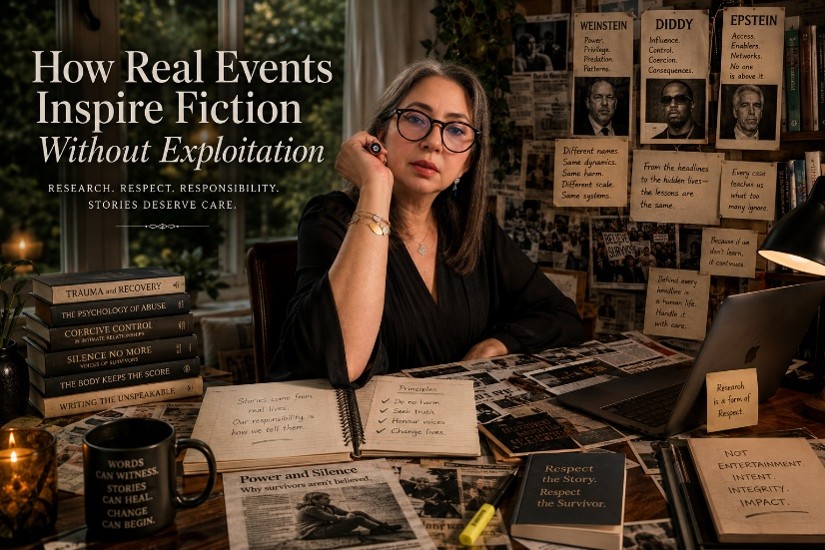
Stories can begin in many places: a newspaper headline, a conversation that lingers, a case file, a historical event, a community legend, or a question that refuses to go away.
For writers who explore difficult subjects such as violence, trauma, injustice, and loss, inspiration often comes from real life. That creates an ethical challenge: how do we draw on actual events without exploiting the people behind them?
As both a psychologist and a novelist, I have returned to this question throughout my writing career. For me, the answer begins with understanding the difference between suffering and learning from it.
Stories deserve care, and so do the people who inspire them.
One of the most common misconceptions about fiction is that characters are direct copies of real people. Fiction rarely works that way.
A single character may draw on dozens of experiences, observations, conversations, and emotional truths. A story may begin with an actual event yet gradually grow into something entirely its own.
The aim is not to recreate someone’s life, but to explore the human questions that emerge from it:
These questions extend beyond any one individual or circumstance. Fiction allows writers to explore them while protecting privacy, preserving dignity, and making room for complexity.
Before I became a novelist, I worked in psychology and advocacy. That experience taught me something essential: research is not only about accuracy; it is also about respect.
Whether writing about domestic violence, child abuse, addiction, grief, trauma, or cultural traditions, I believe writers have a responsibility to understand the realities they depict. That means listening carefully, questioning assumptions, and recognising the limits of our own experience.
When writing Mist and Unappeased Spirits, I researched considerably Mount Nyangani; the disappearances associated with the mountain, and the local folklore surrounding it. I knew especially that these beliefs did not belong to me.
My role was not to explain them away or sensationalise them, but to listen, learn, and approach them with humility.
Mist and Unappeased Spirits also began with a deeply personal connection to Mount Nyangani. My nephew disappeared on the mountain. Extensive searches never found him. That loss stayed with me, and it became part of the emotional landscape from which the novel eventually grew.
Yet this also created another ethical dilemma. As I began researching and writing, family members repeatedly asked me whether I was writing about him. They were afraid the novel might hurt the family or turn private grief into fiction. No matter how much I explained that the story was my own, and not a retelling of his disappearance, the anxiety remained.
There were moments when I nearly gave up the project altogether.
In the end, I had to return to the same principles that guides all my writing: conscience, care, and responsibility. I knew I was not writing his story. I was writing a fictional novel shaped by research, folklore, imagination, and my own emotional response to absence, mystery, and unresolved loss.
Publishing the book revealed that Mist and Unappeased Spirits was not an account of my nephew’s disappearance. It belonged to its own characters, its own mythology, and its own emotional truth. But the experience taught me how carefully writers must tread when fiction grows near genuine grief.
The same principle applies when writing about violence or trauma: accuracy matters, but respect matters just as much.
Sun on Your Back was born out of my work with survivors of sexual violence, physical violence, and incest in Zimbabwe. Transforming those experiences into fiction was a mammoth and deeply careful task. I had to revisit years of professional case histories and ask myself how I could draw upon the emotional and systemic truths they revealed without exposing the individuals who had trusted me.
The responsibility was enormous. I was not interested in reproducing anyone’s private suffering on the page. I wanted instead to explore the patterns I had witnessed: trauma, silence, disbelief, victim-blaming, family loyalty, and the gaps within social and legal systems meant to protect the vulnerable.
It took me five years before I felt satisfied that the process had harmed no one. By then, the characters I had created belonged wholly to the novel. They did not represent disguised versions of clients or borrowed lives. They were fictional people shaped by wider truths, careful research, and a commitment to dignity.
That process taught me that ethical storytelling is not only about changing names or altering details. The key is to understand what to protect and what to reveal.
I was not exposing individuals. I was exposing patterns.
My research also extended to the other side of abuse: the psychology and behaviour of perpetrators. In Zimbabwe, I drew upon prison-based research with men convicted of sexual offences against children. The purpose was never to excuse their actions, but to understand patterns: how they thought, how they justified harm, when abusive behaviour began, what histories shaped them, and how they viewed their victims.
That research was deeply uncomfortable, but it was necessary. If fiction is to explore abuse honestly, it cannot rely only on the idea of the perpetrator as a monster who appears without context. It must also examine entitlement, denial, grooming, minimisation, and the ways people learn to silence conscience.
This work eventually informed Andre’s Story, the fictional short story connected to Sun on Your Back. Andre was not based on one individual. Wider research, professional experience, and the desire to understand intergenerational harm shaped him into a fictional character.
Understanding is not forgiveness. Explanation is not absolution. But careful research can help fiction portray difficult human behaviour with greater honesty, and that honesty matters when the subject is abuse. Researchers also linked understanding perpetrator behaviour to prevention. If we want to protect children and support survivors meaningfully, we have to understand how grooming begins, how offenders justify their behaviour, how families and communities miss warning signs, and how silence is maintained.
Long-term prevention depends on more than telling children to speak up. It requires adults, professionals, families, and communities to recognise patterns of abuse before damage becomes irreversible. Uncomfortable research can become part of a wider protective framework.
So, research has always mattered to my fiction. It helps ensure that difficult subjects avoid reduction to shock or stereotype. Researchers explore them with the seriousness needed to understand harm, expose silence, and imagine better forms of protection.
Fiction’s ability extends past shock or stereotype. It helps writers understand survivors, systems, and prevention with greater seriousness. It questions not only what happened but also the origins of harm, its perpetuation, its concealment, and potential future prevention strategies.
There is an important difference between representing difficult experiences and exploiting them. Exploitation seeks shock. Representation seeks understanding. Exploitation turns suffering into spectacle; representation places it within the context of a human life.
When I write about violence, I am rarely interested in graphic detail. What interests me far more are the emotional, psychological, and social consequences that follow.
These questions often reveal far more than explicit descriptions ever could. The aim is not to entertain readers with suffering, but to illuminate human experience.
Not all inspiration comes from private experiences. Some stories arrive through public events.
Over the past several years, I have written extensively about high-profile cases involving abuse, coercion, and power. I am interested in such cases not for their celebrity, but for what they reveal.
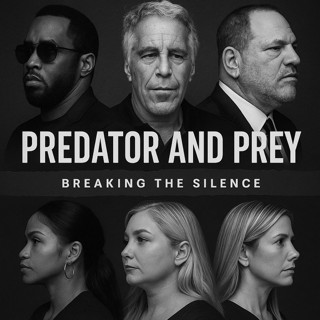
I have deliberately chosen not to centre the names of those involved. The individuals themselves are not the point. What matters is what these cases reveal about flawed systems: the disbelief faced by victims, the protection often afforded to powerful people, the hesitation of institutions, and the way reputation can be treated as more valuable than truth.
For me, the greatest lesson from these public cases is not simply that abuse occurred. It is that it could continue for so long because the surrounding systems failed. That failure is what makes these stories important from an advocacy perspective. They expose not only individual harm, but the structures that allow harm to be hidden, minimised, or ignored.
High-profile cases often function as mirrors, reflecting patterns that extend far beyond the individuals involved. They give us a way to examine victim-blaming, coercive control, trauma responses, grooming, institutional failure, and public attitudes toward survivors.
What makes these stories valuable from an advocacy perspective is not their notoriety, but their visibility. The dynamics they expose are often the same ones experienced every day by countless less visible people:
Different names and different circumstances, but often the same patterns. Public cases help us recognise those patterns more clearly.
Advocacy works on many levels. Research and statistics help shape policy, while training helps professionals apply that policy fairly. Public understanding helps communities recognise harm and support those affected by it.
Stories play an important role in that last layer. They help people connect emotionally with realities they may never experience personally, challenge assumptions, humanise statistics, and invite reflection rather than forcing conclusions.
Whether through fiction, memoir, journalism, or public testimony, storytelling remains one of the most powerful ways we make sense of complex human experience.
I often think about the responsibility that comes with telling stories. Every writer makes choices about what to include, what to leave out, whose perspective to centre, and how to portray vulnerability and pain. Those choices matter.
For me, the guiding principle is simple:
That does not mean every story must be comfortable; many important stories are not. However, we must never sacrifice human dignity for the sake of drama.
There is a tendency to view stories as separate from reality. Yet stories shape how we understand reality: they influence what we notice, affect whom we believe, and challenge myths we have accepted without question.
When approached thoughtfully, stories inspired by actual events can deepen empathy, encourage critical thinking, and broaden public understanding.
The goal is not to borrow someone else’s pain. It is to understand what that pain reveals about being human.
Actual events may provide the spark. Research may provide the framework. But storytelling, at its heart, is about connection, and connection begins with listening.