
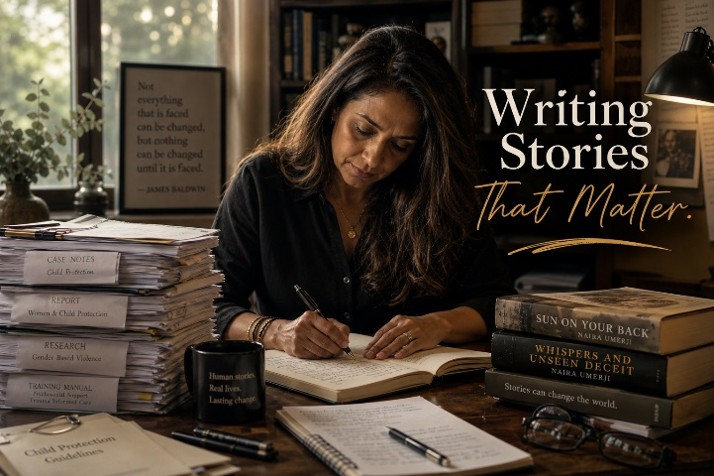
Stories have always shaped how we understand the world and one another. For me, storytelling was never simply about imagination. It became a way to carry voices that are too often unheard.
Psychology and advocacy formed the foundation of my work long before I began writing fiction. I worked with women and children affected by violence, first in Zimbabwe and later through international platforms, including the United Nations. The way abuse quietly and often invisibly reshapes lives was something I witnessed. Also saw how systems meant to protect can fail, sometimes through inaction, sometimes through silence.
Over time, I returned to a troublesome question: How do we help people feel what statistics alone cannot convey?
Statistics inform, but they can also create distance. Without an emotional connection, there is often little urgency to act. Advocacy itself operates on many levels. Research and statistics are essential because they reveal the scale and impact of harm. They allow policymakers to identify patterns, develop protections, and strengthen laws.
There is little point in good legislature unless trained personal implement it. The budget for these needs to be included in the national budget. The people responsible for implementing those laws, including police officers, magistrates, healthcare workers, teachers, and social services, also require training that helps them recognise trauma without bias. Without that understanding, victim-blaming, disbelief, and the minimisation of harm can persist even within systems designed to offer protection.
Yet advocacy must also reach beyond institutions.
It must reach ordinary people: those living with violence, those vulnerable to exploitation, and those who may not yet understand their rights or recognise that what they are experiencing is abuse.
That is where storytelling can become especially powerful.
But legislation alone is not enough. Fiction became my answer.
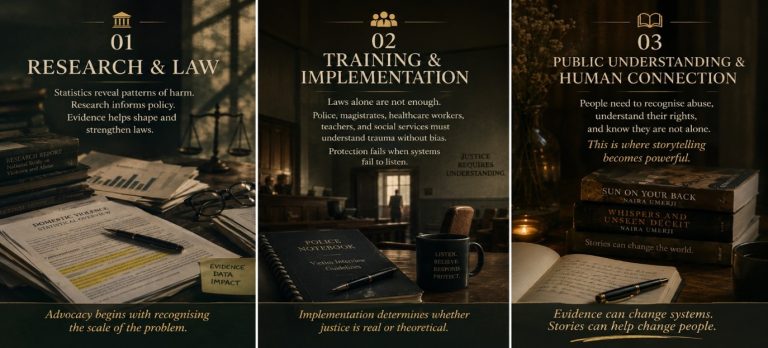
Statistics may shape laws, but stories help carry understanding beyond institutions and into everyday human experience.
Fiction creates an emotional connection. It allows readers to recognise themselves, question assumptions, and feel less alone. In doing so, it can carry conversations about violence, silence, prejudice, and survival beyond academic reports and policy discussions into everyday human understanding.
My earlier work involved training in observation, assessment, and documentation. There was structure to everything: reports, evaluations, recommendations. Yet behind every case file existed a human story that clinical language could never fully contain.
One incident stayed with me.
As a young intern, I was called to speak to a teenage girl who had overdosed on painkillers. After her hospital discharge, she refused to return home, so they placed her in foster care.
Over time, as we spoke, the truth emerged. The root cause was incest.
My belief in her was immediate and unwavering. The consistency of her account, the detail she remembered, and the emotional landscape she described reflected lived experience.
What became increasingly difficult to ignore, however, was that the systems surrounding her did not mirror that understanding.
The structures meant to protect her struggled to see her clearly. There was hesitation, doubt, and a quiet undercurrent of victim-blaming alongside an instinct to excuse the perpetrator. It was not always explicit, but it existed in the questions asked, the responses withheld, and the absence of decisive action.
Children do not always present trauma in ways adults expect. They may freeze. They may become confused. Their language is limited, particularly when they are trying to describe experiences that should never have entered their world.
They do not lie in the ways we fear. They struggle to be understood.
This young girl had tried to speak before. She had told both a doctor and a teacher, yet neither had truly heard her. That realisation stayed with me.
It revealed a gap between experience and recognition, between truth and belief.
Sun on Your Back grew from that space. It became both her journey and mine: a way of giving narrative form to experiences that are often dismissed, misunderstood, or silenced. It also challenged the myths that continue to surround abuse, including the idea that clothing invites harm or that some individuals are less vulnerable than others.
They are not.
There are subjects people instinctively turn away from: abuse, exploitation, trauma, and the failures of trusted systems. Fiction provides a space for a gentler, yet equally truthful, approach to these realities.
While writing this story, I wanted readers to step beyond the safety of observation and walk alongside the character instead: to understand, to feel, and ultimately, to believe her.
Storytelling makes that possible. It allows us to approach hard truths through human connection. A reader may resist an argument, but it is far harder to turn away from someone whose inner world they know.
What I did not fully expect was the response the novel would receive.
After publishing Sun on Your Back, I received messages from readers who recognised parts of themselves within the story. Some shared experiences they had never spoken about before. Others wrote only a few words: “This happened to me too.”
Those messages felt less like feedback than acts of trust.
They stayed with me in unexpected ways. I was humbled by them and reminded that stories extend beyond the page. They continue in the lives of those who recognise themselves within them. And with that recognition comes something powerful: the possibility of being seen and, perhaps, finally, believed.
Advocacy is often associated with policy, campaigns, and public speaking. These are important tools, but they are not the only ones.
Fiction can challenge assumptions. It can question the narratives we accept without thinking. It can reveal how power operates quietly and how societies sometimes overlook harm when it does not fit familiar expectations.
Through storytelling, we can humanise statistics, expose systemic failures, and explore the emotional realities that exist behind legal and social frameworks. Fiction creates space for readers to engage with difficult subjects in their own way and at their own pace.
It does not demand agreement. It invites reflection.
Moving from advocacy into fiction was never a departure from my work. It was a continuation of it in another form.
My current novel, Whispers and Unseen Deceit, continues to explore many of these themes. It examines how communities maintain silence, how power protects wrongdoing, and how truth often emerges slowly and at considerable personal cost.
At its core lies a question that extends far beyond fiction:
What happens when people know, but choose not to act?
Progress in this area has often been painfully slow. Systems rarely change quickly, particularly when power, reputation, and longstanding social attitudes are involved. Yet in recent years, we have also witnessed something important: more survivors speaking openly about their experiences and more people willing to listen.
That shift matters.
For generations, many victims kept their experiences to themselves, often believing no one would believe them or fearing the repercussions of speaking out. While those fears have not disappeared, collective voices have challenged the culture of silence that has protected harm for so long.
For me, this remains one of the most important aspects of advocacy: creating a space for people to speak and ensuring that those who listen treat the voices with dignity, seriousness, and compassion.
Genuine change rarely begins in institutions alone. It begins when people feel able to tell the truth about what they have lived through and when others will listen.
There is a tendency to separate fiction from reality, to view one as entertainment and the other as truth. Yet the boundary between them is often far more fluid than we realise.
When grounded in lived experience, careful research, and emotional honesty, fiction can illuminate realities that are difficult to access in other ways. It can reach readers who may never engage with traditional forms of advocacy and remain with them long after the last page.
For me, writing is not about telling people what to think. It is about creating stories that encourage readers to look again: at systems, at assumptions, and sometimes at themselves.
Because change rarely begins with information alone. It begins with understanding.
And sometimes, understanding begins with a story.