
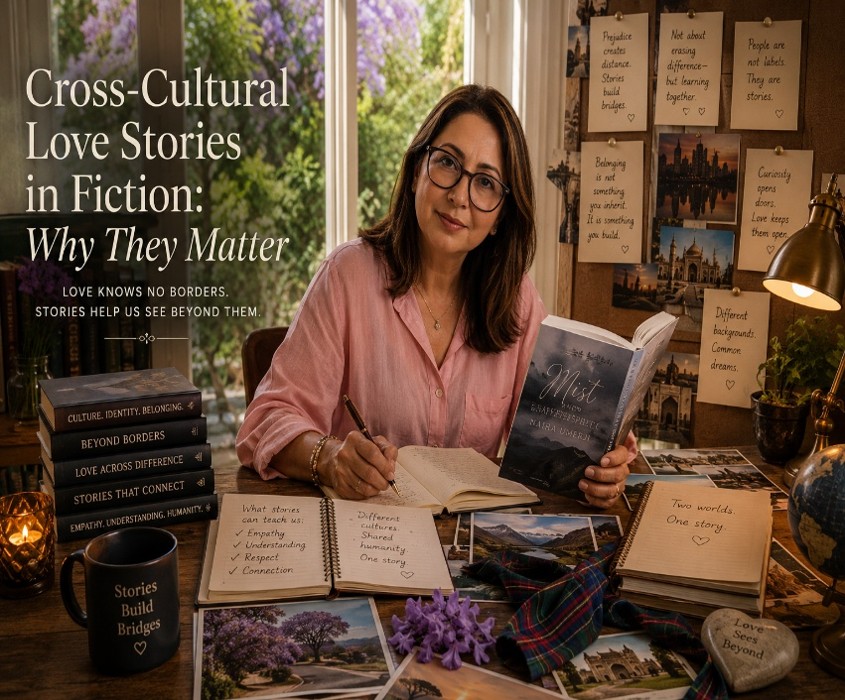
Some of the most enduring love stories in literature are not simply about romance. They are about crossing boundaries that society insists should remain in place. Emily Bronte’s novel Wuthering Heights often refers to Heathcliff as ‘gypsy’ or uses similar derogatory words because of his dark skin. Mr Darcy in Jane Austen’s Pride and Prejudice described Elizabeth Bennet as being of inferior birth, lower social standing, lack of fortune, and the embarrassing behaviour of her family. However, despite all these flaws in her, he still wanted to marry her! He was very surprised that despite all these obstacles, she rejected him!
Cross-cultural stories remind us that while traditions, beliefs, and backgrounds may differ, many human hopes remain remarkably similar.
Cross-cultural love stories allow readers to step into lives that may differ from their own. Through romance, readers encounter unfamiliar traditions, family expectations, religious practices, languages, histories, and ways of seeing the world. Yet because the doorway is love, the unfamiliar becomes intimate rather than distant.
At their best, these stories do more than place two lovers from different backgrounds together. They invite curiosity, and curiosity asks readers to look beyond labels. Once we see the individual beneath the category, difference becomes less threatening and shared humanity becomes easier to recognise.
Love stories across cultures often reveal how much people have in common, even when their worlds appear far apart. The desire to be seen, chosen, respected, and understood is deeply human. Nationality, race, religion, or class does not limit it.
Traditions, beliefs, and backgrounds may differ, but many human hopes remain remarkably similar.
This is one reason cross-cultural fiction matters. It can gently challenge fear and assumptions by allowing readers to spend time inside another person’s world. Instead of encountering difference as an argument, readers encounter it through character, emotion, family, conflict, and tenderness.
Stories can make strangers feel less strange.
They can show that love is not only about attraction between two people. It can also become a bridge between histories, communities, and ways of belonging.
In many cross-cultural love stories, the deepest conflict is not always between the two people in love. Often, the couple understand one another far more clearly than the world around them does.
The real obstacles are frequently external: family expectations, religious prejudice, racial assumptions, class boundaries, community pressure, and fear of social judgement. Love may begin privately between two people, but cross-cultural relationships often become public quickly. Suddenly, a relationship is no longer simply about affection or compatibility. It becomes belonging: the family accepts some people, considers others suitable, and quietly expects some to remain at the edge of the room.
This is where fiction becomes powerful. It allows us to examine the ways societies police love. Sometimes that policing is open and aggressive. At other times, it arrives in softer language: concern, tradition, practicality, reputation, or “thinking about the future.”
But beneath those phrases often lies the same question:
Does this person fit our idea of who belongs with us?
Cross-cultural fiction reveals how others easily assign labels to people before recognising their individuality. A woman may become “too different,” “too modern,” “too religious,” “not religious enough,” “from the wrong background,” or “not the person our family expected.” The language changes, but the judgement is often the same.
The greatest challenge in these stories is not always learning to love one another. It is surviving the assumptions others bring to that love.
That is why these stories matter. They reveal how prejudice often hides inside ordinary conversations, family expectations, and polite warnings. They show how love can become a test of courage, not because the couple lack feeling, but because the world around them demands explanation, permission, or conformity.
At their strongest, cross-cultural love stories ask us to consider whether we are truly open to difference, or only comfortable with it when it remains safely outside our own homes.
Cross-cultural love is not only a theme in contemporary romance. For many people, history, law, race, religion, migration, and family expectations have shaped them.
In Sun on Your Back, apartheid South Africa casts a shadow over André and Sophia’s relationship, as society and politics condemned love across racial and cultural boundaries. Their decision to leave South Africa for Zimbabwe reflects a world in which marriage, belonging, and laws and prejudices designed to keep people apart shaped family life.
The novel does not romanticise their marriage. What matters for this discussion is the world they came from and the way racial boundaries shaped the choices available to them. Their relationship shows how love, in certain contexts, could become an act that challenged the social order.
A later generation faces a different version of the same problem through Diara and Xander. The prejudice is no longer expressed through apartheid law, but through family expectations, social discomfort, and quiet warnings. When Xander is advised to think carefully about pursuing Diara because of how difficult it might be to take her home to his parents for Sunday dinner, the question is about romance. It is about belonging.
That kind of prejudice often disguises itself as practicality.
I also grew up hearing another troubling distinction made in relation to sons and daughters who married outside their religion or community. If a son married a woman from a different background, some thought the family could come to terms with it since they expected her to adapt, submit, or convert. But if a daughter chose someone regarded as a “non-believer,” the reaction was often far harsher. Her choice brought disgrace, betrayal, or shame upon the family.
I never understood the moral logic of this distinction. If faith and culture are truly the concern, why should the rules change according to the gender of the person who falls in love?
Over time, I came to see that this was not only about religion. It was about control. Family authority extended through sons, and daughters guarded family honour.
Cross-cultural love stories matter because they expose these double standards. They show how love becomes threatening when it challenges inherited ideas about obedience, belonging, gender, and who may choose.
Across generations, the question takes different forms but keeps the same meaning: who do people consider acceptable, who do they welcome, and who do they expect to stay outside the room?
Love Beyond Labels: Ara, William, Mahira, and Kemal
In Mist and Unappeased Spirits, Ara and William’s relationship explores another kind of crossing. Ara is a young Zimbabwean Muslim woman studying medicine in London. A Scottish aristocrat, William belongs to a family whose expectations stem from class, tradition, and inherited social circles.
On the surface, their differences are obvious: culture, religion, race, nationality, and social background. Yet what interested me most was not simply the fact that they came from different worlds. It was the way they gradually learned to see one another as individuals rather than representatives of those worlds.
Their relationship is tender, complicated, and imperfect. Prejudice affects their relationship as well. Lady Robertson’s response to Ara reveals how quickly tolerance can collapse when difference enters the family home rather than remaining a polite idea at a distance. Lady Robertson does not reject Ara solely because of her identity, but because of the meanings she attributes to her.
This is one reason cross-cultural love stories matter. They reveal how often people judge others before knowing them.
Mahira’s story adds another layer. Her earlier relationship did not fail because of obvious cultural differences. On the surface, her former fiancé came from a world closer to her own. Yet his family rejected her because she did not conform to their expectations of how a Muslim woman should dress, behave, or belong. She pursued education, maintained her independence, lived a modern life, and would not let others confine her to their narrow definition of respectability.
There is often fear beneath this kind of judgement. In many communities, people regard women who are vocal, educated, independent, or aware of their rights as dangerous. Others may label them “too modern,” “too outspoken,” or morally suspect, not because they have done anything wrong, but because they refuse to remain small enough to make others comfortable.
Sometimes, people viewed women who understood their rights with suspicion. Men might dismiss them as difficult or promiscuous, while other women might secretly envy the freedom they represented. This is one of the quieter ways social controls operate. It disguises fear of female independence as concern for respectability.
I was once visiting a friend in Zimbabwe when another guest, a younger woman, sat with us for part of the afternoon. She was quiet, reserved, and wore a hijab. Yet as my friend and I chatted and laughed, I noticed that she never seemed to take her eyes off me. After she left, I asked whether I had offended her.
The answer stayed with me.
I was told that perhaps I had, but not because of anything I had said. Rather, the freedom I represented may have unsettled her: the freedom to laugh openly, speak easily, pursue work, ideas, and a life beyond the narrow boundaries she expected.
That moment taught me something about judgement between women. What looks like disapproval may sometimes conceal longing. Women who seem to condemn another woman’s independence may, in private, envy the very freedom they have learned to fear or deny themselves.
This is part of Mahira’s emotional history. She knows what it means to be judged not because she lacked faith or values, but because she did not perform them in the way others demanded.
In contrast, Kemal is Turkish, with a different cultural background from Mahira’s Zimbabwean Asian upbringing. Yet he meets her with respect, curiosity, and acceptance that her former fiancé’s family never offered.
Through Mahira and Kemal, I wanted to explore the idea that a shared background does not always guarantee understanding, and difference does not always prevent it.
Sometimes the person who truly sees us is not the person who comes from the same world, but the one willing to meet us without trying to make us smaller.
One of the most powerful things fictions can do is challenge prejudice without turning the story into a lecture.
Prejudice often survives because people rarely encounter those they fear, dismiss, or misunderstand as fully realised human beings. They encounter labels instead: Muslim, foreign, modern, traditional, aristocratic, common, respectable, unsuitable. Once a person becomes a label, it becomes easier to judge them without curiosity.
Stories resist that.
A novel allows readers to spend time inside another person’s world. They witness private thoughts, fears, hopes, contradictions, and vulnerabilities. They see how someone loves, grieves, doubts, dreams, and survives. That kind of emotional proximity is difficult to achieve through argument alone.
In Mist and Unappeased Spirits, Lady Robertson’s response to Ara is not simply personal dislike. It reflects a wider pattern of performative tolerance. Difference is acceptable at a distance, in polite conversation, or as an abstract principle. It becomes more threatening when it enters the family home, sits at the dinner table, and asks to be accepted as an equal.
Fiction gently exposes the gap between what people claim to believe and how they behave when their own social boundaries challenge them.
Cross-cultural love stories also reveal how stereotypes work. Ara is not judged solely as Ara by people. People filter her through assumptions about religion, race, class, and belonging. People do not judge Mahira only as Mahira. Others compare her to their own idea of how a Muslim woman should dress, speak, and live.
These assumptions are not always loud. Sometimes they arrive through politeness, concern, family reputation, or tradition. Yet their effect is powerful. They decide who gets a warm welcome, who faces doubt, and who must exert more effort to be clearly understood.
Fiction matters because it gives the labelled person back their full humanity.
It asks readers to look again.
Despite the prejudice and resistance, they often explore, cross-cultural love stories are also stories of hope.
Not because love magically removes differences. It does not. Culture, faith, family history, language, class, migration, and community expectations all shape how people see themselves and one another.
But love can create the desire to understand.
At their best, these relationships show curiosity, patience, compromise, and growth. They show people learning not only about another person’s background but also about their own assumptions. Understanding is not passive. It is something people choose, practice, and build.
These stories are powerful not because difference disappears, but because people continue reaching for one another despite it.
The reaching matters.
It suggests that identity does not have to become a wall. It can become a doorway into conversation, tenderness, discovery, and a more generous way of seeing the world.
Cross-cultural love stories are not only about romance. They are about the courage to imagine belonging differently.
Cross-cultural love stories matter because they ask readers to examine the boundaries they have inherited.
We consider who people welcome, who they expect to adapt, and who they judge before understanding them. They expose the quiet rules that govern families, communities, and social circles. They show how prejudice can hide beneath tradition, practicality, respectability, or concern.
But they also offer another possibility.
They suggest people can meet across differences with no need to erase them. They show that love can challenge inherited fears, not by pretending difference does not exist, but by refusing to let difference become the complete story.
That is why fiction remains such a powerful space for exploring these relationships. A novel gives readers time. Time to know a person beyond the label and to understand what shaped them. Time to see the hopes, fears, contradictions, and longings that make them human.
And perhaps that is where the true power of these stories lies.
They do not simply ask whether two people from different worlds can love one another. They ask whether the rest of us can become brave enough, humble enough, and curious enough to let them.
In a world that often encourages division, stories that cross boundaries remind us that human connection begins when we become curious about one another.
Love stories that cross boundaries endure because they ask us to imagine a world where understanding is stronger than fear.