
There are places in the world that don’t just exist, they speak.
Not in words, but in stones, winds, ruins, and memories carried through generations.
Zimbabwe is one of those places.
When you encounter its landscapes, you are not simply observing destinations marked on a map. You are stepping into layered histories of kingdoms, identity, survival, spirituality, and cultural memory. This is what makes Zimbabwe UNESCO heritage sites far more than preserved locations. They are living narratives of human civilization.
So instead of treating them as points on a journey, let us understand them as stories that continue to shape meaning today.
Imagine standing before massive stone walls, carefully stacked without mortar, shaped by hands that lived nearly a thousand years ago. The air is still, but it does not feel empty. It feels inhabited by memory.
This is the essence of Zimbabwe travel storytelling, where landscapes do not simply exist — they remember.
Zimbabwe does not present itself as something to be consumed quickly. It invites reflection.
Because here, heritage is not confined to museums. It is embedded in stone, carried in oral tradition, and preserved through generations like a living archive of identity.
This is why engaging with the UNESCO sites in Zimbabwe list is not about tourism. It is about understanding continuity.
If Zimbabwe had a physical memory of power and civilization, it would be Great Zimbabwe.
This UNESCO World Heritage Site represents the remains of a powerful medieval civilization that shaped trade, leadership, and cultural systems across southern Africa.
But beyond its physical structure lies something deeper, meaning.
The true story of Great Zimbabwe is not only in its architecture, but in its questions.
How were these stones moved and placed with such precision without modern tools? Why were the walls designed in such intricate patterns? What systems of knowledge, belief, and leadership shaped this space?
Local oral traditions suggest that Great Zimbabwe was more than a political center. It was a place where leadership, spirituality, and ancestral connection were deeply interwoven.
This is where African heritage storytelling becomes essential. Great Zimbabwe is not just an archaeological site. It is a cultural memory that continues to inform identity, belonging, and historical understanding today.
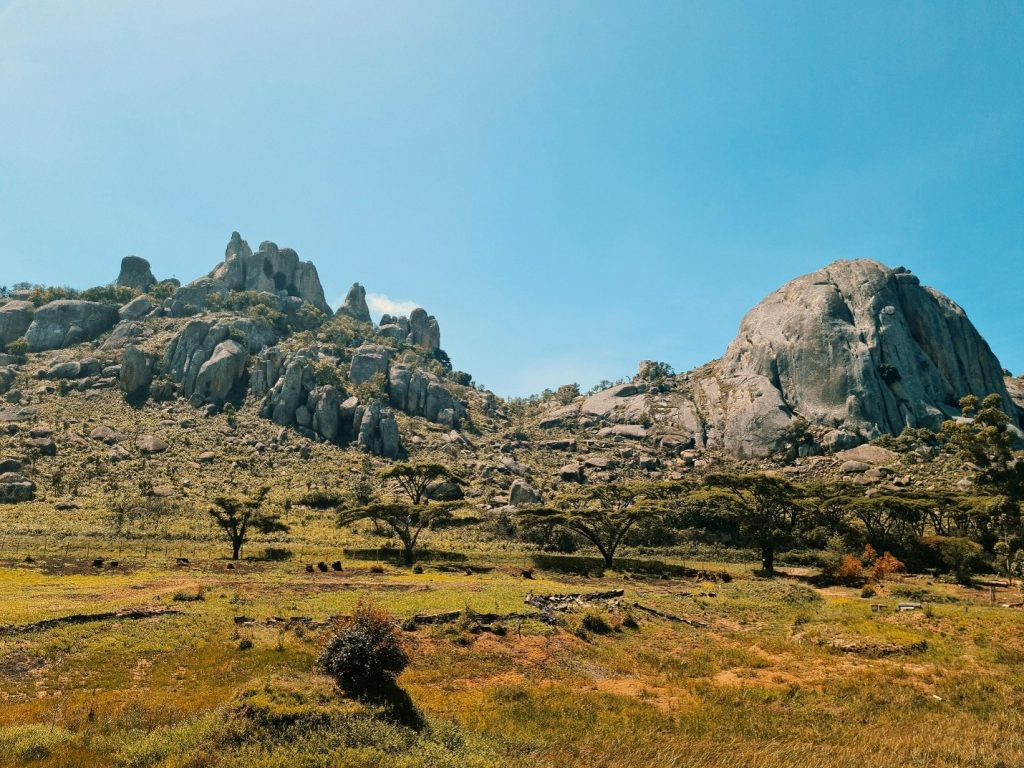
Matobo Hills is not defined by silence, but by presence.
Its balancing rock formations and ancient granite landscapes create a space that has long been associated with spiritual meaning and ancestral connection.
For centuries, this region has been regarded as a place where the physical and spiritual worlds are closely linked. The land itself is seen as a medium of memory and communication.
Cave paintings preserved within the hills offer insight into early human expression — depicting survival, ritual practice, and relationships with nature.
This makes Matobo Hills a powerful example of cultural tourism Zimbabwe in its truest sense: not as sightseeing, but as engagement with belief systems embedded in landscape.
Here, the land does not simply hold history, it expresses it.
Not all heritage is built by human hands.
Some heritage breathes.
Mana Pools National Park, a UNESCO-listed site, represents an ecosystem that has existed in balance for thousands of years.
The movement of elephants along riverbanks, the presence of predators, and the flow of the Zambezi River all form part of a natural system that continues to sustain life.
But beyond its ecological importance, Mana Pools reflects a deeper truth: heritage is not only human construction. It is also environmental continuity.
In the context of heritage tourism Africa, this site expands understanding beyond architecture and ruins. It reminds us that land, wildlife, and survival are part of the same historical narrative.
Khami Ruins often remain less discussed than Great Zimbabwe, yet their historical significance is equally profound.
Once the capital of the Torwa dynasty, Khami was a center of political authority, trade, and cultural development.
Today, its terraced stone structures stand in quiet dignity, holding fragments of a civilization that once thrived.
Khami represents how history does not disappear, it transforms into silence, waiting to be interpreted again.
This is why UNESCO Africa travel guide discussions often emphasize sites like Khami. They remind us that absence does not mean erasure; it often means continuity in a different form.
To look at these sites only as physical landmarks is to miss their deeper meaning.
Facts describe structure.
But storytelling reveals significance.
This is the foundation of storytelling travel Zimbabwe, a way of understanding heritage not as information, but as lived experience passed through generations.
Through this lens, Great Zimbabwe becomes a symbol of identity.
Matobo Hills becomes a space of spiritual continuity.
Mana Pools becomes a reflection of natural balance.
Khami becomes a memory that resists disappearance.
Together, they form a narrative that extends beyond geography into cultural consciousness.
When we speak of Zimbabwe cultural experiences, we are not only referring to places, but to ways of remembering.
These experiences live in oral traditions, community knowledge, and collective identity.
Local storytelling, ancestral respect, and cultural preservation continue to shape how history is understood and passed forward.
This is what makes Zimbabwe distinct in global heritage discussions, it does not separate people from history. It keeps them within it.
Zimbabwe’s UNESCO-listed locations are not isolated monuments. They are part of a wider human story.
They reflect how societies-built systems of leadership, belief, survival, and environmental balance long before modern frameworks existed.
In a rapidly changing world, these sites serve as anchors of reflection.
They remind us that heritage is not static. It is ongoing.
And that is why Zimbabwe UNESCO heritage sites matter, not only for preservation, but for understanding what it means to remember.
To move through Zimbabwe’s heritage is not to travel through space, but through memory.
These places do not speak loudly. They speak through presence.
Through stone that still stands.
Through landscapes that still hold meaning.
Through stories that still circulate across generations.
This is the essence of Zimbabwe travel storytelling, not movement, but listening.
Because some places are not meant to be simply seen.
They are meant to be understood.
And Zimbabwe is one of those places.
Zimbabwe’s heritage is filled with stories that extend far beyond a single place or moment in history. If you enjoyed this exploration of cultural memory, identity, and preservation, discover more thought-provoking stories and reflections on the Destiny Motif blog