
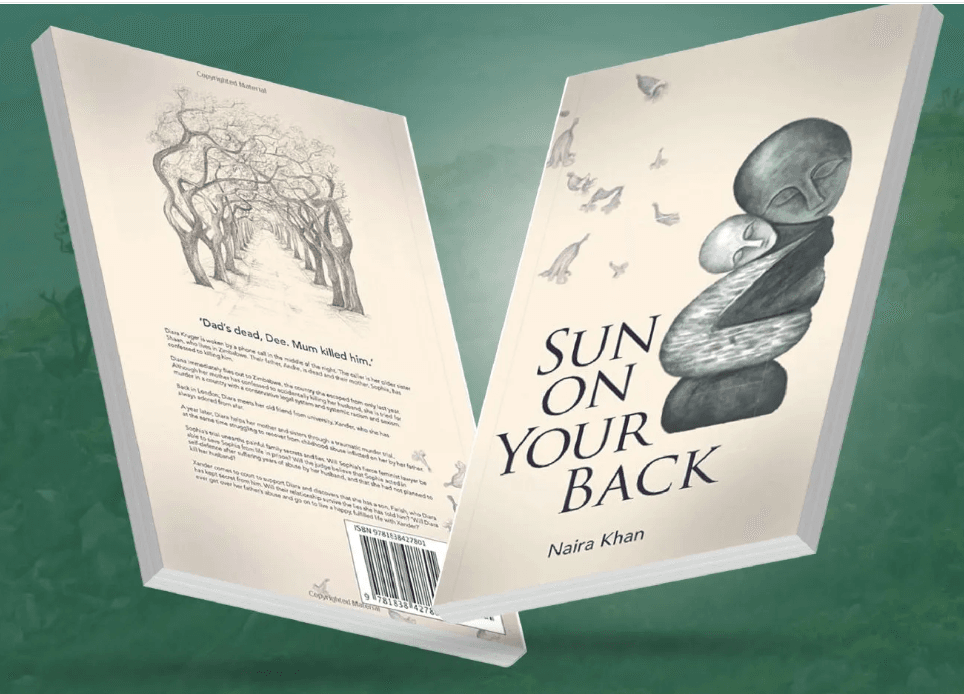
When a book begins with a confession that shatters a family’s perception of safety, few readers can resist leaning in a little closer. Sun on Your Back is that rare novel which starts with a jolt, a daughter waking to the news that her mother has admitted to killing her father, and then proceeds to unravel the emotional architecture of trauma, power, and healing in a way that feels both intimate and universal. This is not just a story; it is an exploration of pain and resilience, a testament to how some narratives must be told and heard.
Naira Khan, the Sun on Your Back Author, brings to this book something more than literary skill, she brings lived sensitivity and psychological depth. In her own Author’s Note for Sun on Your Back, Khan reveals that she did not write fiction lightly. Her background was originally in psychological assessment and research, and she took a yearlong course in novel writing to ensure she could tell this story with craft and care. Five years of research into domestic abuse, family trauma, and survival shaped the narrative’s backbone. Through this foundation, Khan bridges rigorous understanding with powerful storytelling, demonstrating what inspired Sun on Your Back and why this novel was written in the first place.
While the characters and narrative are fictional, they are rooted in real patterns of domestic violence and emotional harm, drawn from case studies and psychological insight. As the author writes, “Some stories demand to be told. This is one of them.” That line alone tells you the weight and purpose behind the literary journey that follows.
What inspired Sun on Your Back goes beyond dramatic plot mechanics. Khan’s inspiration came from the unspoken experiences of survivors, especially women who navigate systems that often fail to see their suffering. The novel’s protagonist, Diara Kruger, embodies this reality: she must return from London to Zimbabwe when her mother confesses to her husband’s death, a situation whose complexity soon transcends legal definitions and enters the murky realms of psychological truth.
Through meticulous research, Khan drew on real legal and sociocultural dynamics, exploring how domestic abuse, both physical and emotional, persists long after the visible wounds fade. Her research wasn’t just academic; it was empathetic and qualitative, walking alongside the stories of those whose voices might otherwise be unheard.
At its core, Sun on Your Back is a book about survival and the long shadows cast by violence. The title serves as a metaphor: the warmth of light against your back suggests movement away from darkness, from cold trauma toward something warmer and more humane. The sun itself, unseen but felt, becomes a thread that ties together the moments of hope that punctuate a life shaped by suffering.
The novel weaves together several powerful themes. It confronts the harsh realities of domestic violence with nuance, showing not just the obvious physical harm but the deep psychological scars that linger. It also probes complicated relationships within families, exposing how silence and unspoken pain can become legacy burdens passed between generations.
This theme of inherited pain echoes broader insights shared in another blog post from the same author’s site, Family Secrets & Trauma: What Sun on Your Back Teaches Us about Generational Wounds, which looks at how trauma becomes part of a family’s emotional DNA and why breaking that cycle requires confronting what was once left unsaid.
Khan didn’t write Sun on Your Back merely to entertain, she wrote it to illuminate. The book holds a mirror to societies that often overlook the plight of women and children caught in cycles of abuse. In many of the scenes, especially during the courtroom sequences, readers confront systemic barriers, where patriarchal norms and biased legal frameworks make justice difficult, if not impossible, for victims.
In her Author’s Note, Khan states that this story is meant to foster awareness and empathy. She hopes that by revealing the psychological complexity of abuse and survival, readers will come away with a deeper understanding of how trauma lives inside people, long after the physical threats have ended.
The novel’s themes are layered and haunting. One of its central explorations is the nature of emotional trauma, an invisible wound that often inflicts the deepest hurt. Sun On Your Back portrays how survivors carry these memories with them, long after the violence stops, shaping their relationships, personal identity, and their capacity for trust.
Beyond trauma, the book interrogates the legal and social frameworks that survivors confront. Sophia, Diara’s mother, must rely on a legal defense steeped in systemic bias, reflecting real struggles faced by women in conservative or patriarchal societies. As readers, we see not just a murder trial but a trial of truth, where beliefs about gender, power, and authority are constantly questioned.
Although Sun on Your Back is a work of fiction, its honest portrayal of domestic abuse gives it the weight of lived experience. The novel sits firmly within what Destiny Motif describes as fiction about surviving domestic abuse, a genre that matters because it validates real emotional truths while opening doors to empathy and understanding.
In this genre, books don’t just provide compelling narratives; they create spaces where survivors can see reflections of their own stories and where readers can learn the full complexity of abuse beyond stereotypes and misunderstanding. Khan’s novel joins this important tradition by acknowledging that healing is not linear and that many survivors continue battling invisible wounds long after the immediate threat has gone.
By the end of the story, Sun On Your Back leaves readers with a profound message: pain does not define you, but understanding it can free you. Diara’s journey, from disbelief and denial to confrontation and tentative healing, mirrors the real emotional journeys so many have walked. It reminds us that trauma, though often silent, can be acknowledged, understood, and transformed into resilience.
The narrative, in its raw and honest portrayal, extends an invitation to its readers: to look beyond the surface of stories, to grapple with the hidden wounds that shape human lives, and to recognize that the sun, even when unseen, can warm what once felt hopelessly cold.
In weaving together psychological research, empathetic character development, and gripping narrative tension, Sun On Your Back stands as a novel that was not only written but needed to be written, a story of struggle, survival, and the ever-present possibility of healing.