
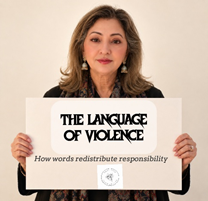
The Language of Violence
How words redistribute responsibility
Daily, headlines and official reports shape how we perceive violence against women and children. What is not so obvious is the subtle linguistic pattern at work. Our routine language systematically erases the person responsible for the harm through passive grammar, softened vocabulary, and abstract phrasing.
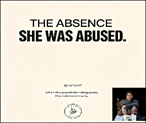
She was abused.
He was no longer in control.
She stayed with him.
Three ordinary sentences. Nothing about them seems remarkable. But look again.
In the first, the person who committed the abuse has disappeared. In the second, his behaviour lost its deliberation: he simply lost control. By the third, something curious had happened. The woman has acquired agency. Now we are examining her choices.
Language has not removed responsibility.
It has redistributed it.
We think of language as something that describes violence after it has happened. But language actively influences violence throughout its existence: it shapes the attitudes that precede violence, forms explanations for perpetrators’ behaviour, guides the questions we ask victims afterward, and constructs the narratives society shares when powerful men finally face consequences.
And at almost every stage, language can influence where we place responsibility.
Before violence: changing how we see women
Violence does not emerge in a cultural vacuum.
Language helps people build ideas about who women are and how to treat them long before an individual act takes place.
This is visible in some of the misogynistic rhetoric circulating online. Online misogynistic rhetoric describes women as manipulative, deceitful, sexually calculating, or primarily interested in extracting men’s money. They also portray women as something belonging to men and therefore legitimately subject to male authority.
Andrew Tate’s rhetoric provides an unusually stark example. He has publicly spoken about women as belonging to men, compared relationships with women to ownership, and promoted ideas about female obedience and male control.
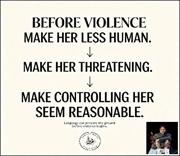
Psychologically, there is something important is happening here.
First, make her less human.
Then make her threatening.
Then make controlling her reasonable.
The apparent contradiction is useful. If men consider women possessions, they believe they can control them. If women are manipulative and dangerous, men have a reason to control them.
Language, without explicitly instructing somebody to commit violence, can still help create a worldview that makes it easier to justify coercion, domination, and control.
And when women are told that avoiding male violence is partly their responsibility, the redistribution has begun before violence has even occurred.
Don’t walk there, drink too much, trust the wrong man, and put yourself in that situation.
The potential victim already bears the responsibility for preventing the potential perpetrator’s behaviour.
When violence happens, where did the perpetrator go?
Then violence occurs.
A woman was assaulted.
A child suffered abuse.
She experienced domestic violence.
We understand all three sentences. But something important is missing.
Who did it?
Passive language is not inherently wrong. Sometimes there are perfectly legitimate reasons for using it. But repeated patterns matter.
Womankind Worldwide has challenged precisely this phenomenon in reporting gender-based violence, observing that stories frequently focus on women who are murdered rather than men who murder, and on women who suffer rape rather than men who commit rape.
As they put it:
“Our grammar holds power.”
Gloucestershire Police has gone further and attempted to change institutional practice. To reduce victim-blaming and misogynistic language and to place responsibility on perpetrators, Gloucestershire Police developed its Words Matter reporting guidelines specifically.
Police and Crime Commissioner Chris Nelson illustrated the difference starkly:
“Women are not ‘groped’ in clubs; men are sexually assaulting them.”
One describes something happening to women.
The other tells us who is doing it.
When violence becomes something that simply happened
Sometimes the perpetrator remains visible, but his agency disappears instead.
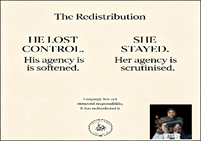
He lost control.
He snapped.
Jealousy overcame him.
Things got out of hand.
These expressions can make violence sound like an emotional weather event that descended upon him.
Compare that with the language surrounding victims.
She stayed.
She went back.
She ignored the warning signs.
She didn’t report it.
She continued speaking to him.
Suddenly there is no shortage of active verbs.
But they belong to her.
We contextualise the perpetrator. We interrogated the victim.
And gradually the question changes.
Instead of:
Why did he do it?
We ask: Why didn’t she leave?
That is not simply a change of subject. It is a change in our understanding of causation.
Her behaviour forms part of our explanation for his violence.
But reverse the causal chain.
Perhaps coercion, intimidation, threats, financial control, isolation, and fear help explain why she stayed.
Now her behaviour no longer explains his violence.
His violence helps explain her behaviour.
When euphemisms change what happened
Sometimes a single word redistributes responsibility.
When a perpetrator’s status becomes his primary description
Consider the language surrounding Jeffrey Epstein.
Financier. A wealthy businessperson. Underage girls.
Sex with minors.
Some of these descriptions may be factually accurate in isolation. But put them together and notice the story they can create.
Compare:
A wealthy financier had sex with underage girls.
with:
An adult sexually abused children.
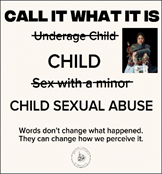
The first foregrounds his status, makes the children sound older, and describes the act using the language of sex.
The second restores the power relationship.
Calling a child an underage girl does not change her age. But psychologically, the words inhabit different worlds.
Language can sanitise without ever explicitly denying what happened.
When abuse is reframed as romance
The same mechanism can operate through framing rather than individual words.
During Sean “Diddy” Combs’ criminal trial, his defence described his relationship with Cassie Ventura as a “great modern love story.”
That phrase matters.
It provides an interpretive frame for viewing everything else. Violence, coercion, affection, sexual behaviour, arguments, and reconciliation can become components of a turbulent romantic relationship rather than evidence requiring examination in their own right.
And this is where questions about victims become powerful.
What made her stay?
What prompted her to send affectionate messages?
What was the reason for her return?
For what reason did she participate?
But affection does not disprove abuse.
Returning does not disprove coercion.
Remaining in a relationship does not constitute retrospective consent to everything that occurred within it.
Language can acknowledge the same events while quietly changing the story those events are being asked to tell.
When the powerful man’s losses become the story
And then there is what happens when a powerful man faces consequences.
The Andrew Mountbatten-Windsor scandal offers a revealing example.
Much of the public conversation became concerned with what the scandal meant for him and for the Royal Family: his reputation, titles, military affiliations, public duties, relationship with the Queen, and the damage being done to the monarchy.
Virginia Giuffre could appear differently within that narrative. She was the woman who made allegations. And after the civil case settled, attention could shift to the money she received.
There is nothing inherently improper about reporting either fact. The question happens through accumulation.
Whose losses are we being invited to contemplate?
Victim-blaming does not always require anyone to state explicitly that a woman is lying.
It is enough to tell us repeatedly what she might have gained while dwelling on everything the powerful man has lost.
The woman whose account precipitated the crisis can gradually disappear while the consequences for the man and the institution surrounding him become the emotional centre of the story.
When the survivor restores causation
Perhaps nowhere is the power of language more apparent than in a victim impact statement.
For months or years, other people may have told the story.
Police.
Lawyers.
Journalists.
The perpetrator.
His defence.
And throughout that process, the victim may have had to explain herself.
Why did you stay and not report sooner? Contact him afterwards? Not remember exactly what happened?
Then, finally, the survivor gets an opportunity to describe the consequences.
The fear, relationships damaged, sleep lost, work affected, and the person she was before and the person she became afterwards.
A victim impact statement does something remarkably powerful.
It restores causation.
For someone who has relied upon denial, minimisation or externalising responsibility, that can be profoundly confronting. The narrative is no longer about what happened to him because of the investigation, trial, or sentence.
It is about what he did to somebody else.
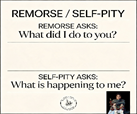
There is an important difference between remorse and self-pity.
Remorse asks: What did I do to you?
Self-pity asks: What is happening to me?
For a few uninterrupted minutes, the survivor gets to answer the first question.
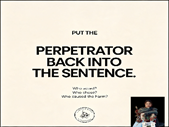
Put the perpetrator back into the sentence
None of this means policing every sentence or banning the passive voice.
It means becoming conscious of what language is asking us to notice.
When we hear about violence, perhaps we should ask:
Who acted?
Whose choices are under examination?
Whose actions are being described?
Which suffering takes up the most room?
Who granted context to whom?
Who is being asked to account for themselves?
Words alone will not end violence against women and children. But language helps shape the world, influencing how people understand, judge, excuse, or challenge violence. It can obscure agency, soften responsibility, and redirect scrutiny toward victims. Or it can make responsibility visible.
Perhaps that is the question we should carry with us when we read the next headline, hear the next explanation, or listen to the next survivor:
Where has the responsibility gone?
Until we talk again,
Naira

Further Reading
If this piece made you look twice at the language surrounding violence, these may be useful next reads.
1.Womankind Worldwide, “The language of gender-based violence reporting”. September 12th, 2024.
2. Gloucestershire Constabulary, “Words Matter” reporting guidelines.
3. Sexual Violence Research Initiative, “The power of language and its use in the GBV field”.
From the Destiny Motif Blog
https://destinymotif.com/trauma-silence-and-healing-in-literature-why-survivor-stories-matter/
https://destinymotif.com/the-story-behind-the-book-sun-on-your-back/
https://destinymotif.com/the-emotional-aftermath-of-leaving-an-abusive-relationship/